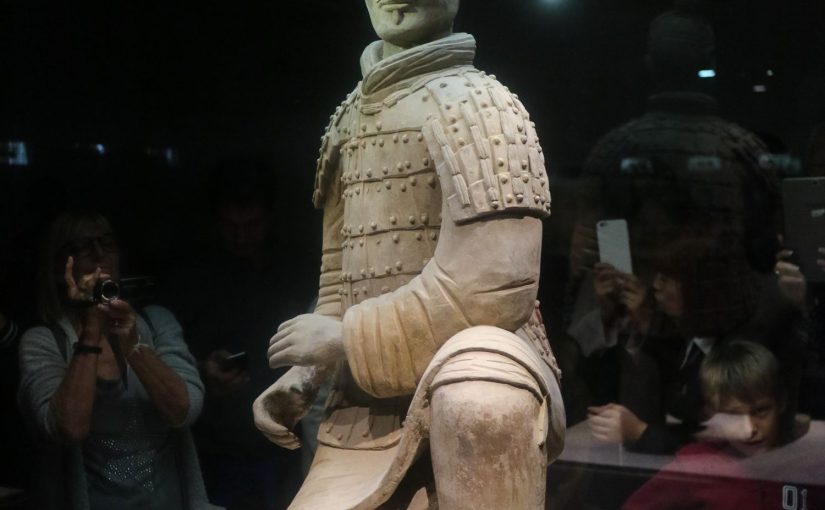
A Korean proverb says that a tiger leaves its skin when it dies, whilst a person leaves their name. However, Qin Shi Huang left behind much more than just the title of the first emperor to unify the Chinese mainland. One of these legacies is the Terracotta Army.
Although this was my first time in China, it was not my first time seeing the Terracotta Army. My memories are hazy as I was very young at the time, but I do recall holding my mother’s hand as we went to see a special exhibition. There, I saw the exquisitely crafted and beautiful terracotta warriors. Driven by the memories and emotions of those childhood days, when I was spellbound by the sight of the terracotta soldiers, I have come to the Terracotta Army Pits today.
As if to make up for yesterday’s struggles, I was in luck from the very start of the day. I met a friendly staff member at the telecoms shop and was able to buy a SIM card, and I had no trouble catching the bus from Xi’an Station to the Terracotta Army Pits. My body was still stiff with tension, but I walked with renewed confidence.
The Terracotta Army Pits, home to the giant terracotta soldiers guarding Emperor Qin Shi Huang, were far larger than I had imagined. Centred around a vast museum displaying the excavated terracotta artefacts, there were three pits open to the public. Even these three pits have not yet been fully excavated; it is said that many more remain. Given the scale of the splendour enjoyed by Qin Shi Huang — who bore the title of the first emperor in Chinese history — even in death, I could scarcely imagine the extent of the power he must have wielded in life.
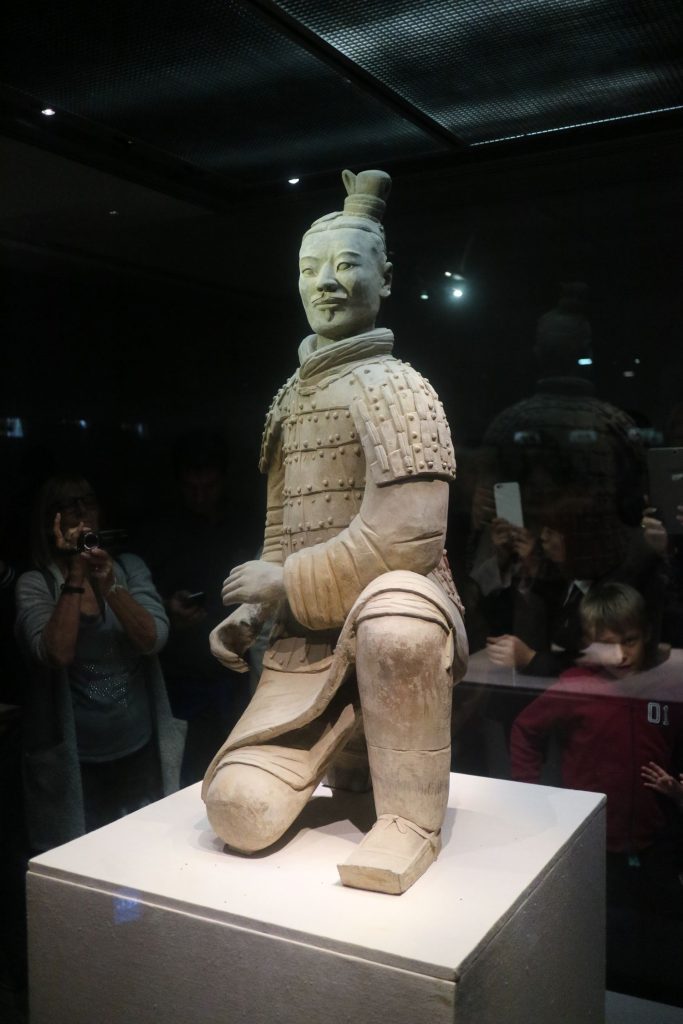
Inside the museum, wandering amongst the terracotta warriors of various shapes, I was completely immersed in nostalgia. For some reason, I felt as though I had been transported back to my childhood, to those days when I used to wander around the museum with my younger siblings. It felt so strange to be there alone, without my family.
And when the actual excavation pit — which I had only ever seen in photographs before — unfolded before my eyes, I paused for a moment to catch my breath. The sight of countless soldiers standing in formation at the bottom of the deep pit was truly spectacular.
‘I must take lots of photos to show them. I’m not sure if they’ll like it, though…’
For my siblings, who were not by my side at that moment, I took photos with great enthusiasm. I felt that the camera lens alone couldn’t capture the emotion I was feeling, so I filmed a video as well. Yet, even as I pressed the shutter, I wasn’t sure I’d ever be able to show these to them.
Since arriving here, I’ve sent my regards to Mum, my friends, and even a junior from university, but I haven’t been able to bring myself to say a word to my younger siblings. When our parents divorced and we went our separate ways, the bond between us was completely severed. Had it not been for Mum, we might not even have managed to see each other and have a meal together before I left the country.
In my memory, the hands of those children I once held in mine seemed like nothing more than a midday mirage.
Before we grew up, we were always together, like the Three Musketeers. I was their leader. The second-oldest would shout, ‘Me too!’ at everything I did, and the youngest would follow me around shouting, ‘Me too, right!’ Yet, as if to mock those days, the older we grew, the further apart we drifted. We would occasionally ask after each other’s lives and laugh together whilst watching TV, but even those superficial exchanges have now vanished.
When did it start? Why did we grow so indifferent to one another? Why was I so uncaring towards them?
How did we, once such close siblings, end up so divided?
Nothing in this world lasts forever. Back when my younger siblings were my closest friends, I believed this bond would remain unchanged even as we grew up. But time does not leave the experiences woven into those years untouched. Just look at Emperor Qin Shi Huang, who dreamed of immortality in his quest for eternal power, yet was ultimately buried beneath the earth alongside his countless terracotta soldiers.
Even whilst standing at the pinnacle of power, where no one dared to look up to him, he had to live in constant fear of assassination, never knowing when he might die. Thus, in his pursuit of the delusional ideal of eternity, the Emperor gradually became a tyrannical ruler who blindly believed in superstition.
Soldiers moulded from clay to guard his afterlife,
The Terracotta Army is, ultimately, a manifestation of Qin Shi Huang’s fear.
For Qin Shi Huang, violence was a means to conquer the continent and seize power. In return, he spent his twilight years steeped in the fear born of an anxious life. Ironically, his mental anguish has been preserved for posterity as this immense cultural legacy.
In our household, Qin Shi Huang was my father. My father, too, used violence as a means to maintain absolute power within the home.
[Know the adults, and know yourself.]
These were the words my father asked me to write when I was in Year 4 of primary school and attending a calligraphy academy. It was then that I realised that this phrase, the meaning of which I did not even understand, was our family motto. My father had it framed and hung it proudly in the centre of the living room. Every time I came home and saw that frame, I felt sick to my stomach.
Literally, it was through my father that we learnt our place. As the absolute ruler of the household, he committed acts of violence under the guise of discipline. It was not merely physical violence. It was accompanied by psychological control, created through his words and the atmosphere he created. And that discipline was generally focused on the sole purpose of pleasing my father.
I was grabbed by the hair and thrown to the floor simply for not putting away the shoe bag that was always left in the hall.
I was starved for a whole day simply because my chopstick technique was deemed odd.
My second sibling was slapped simply for using a foreign-made product.
A loud outburst erupted in the middle of the night simply because he disapproved of the youngest child’s career path.
Furniture was smashed, and objects flew through the air.
My parents fought frequently. Fortunately, my mother was not subjected to physical violence. That said, it was not as though there was no verbal abuse or control. We would only intervene when we sensed my father’s tone becoming slightly more intense. If we made a mistake, the target of his venting would sometimes shift to us. We were generally cautious and remained silent for the most part.
Ironically, my father’s violence failed to dominate us. As we grew up, we simply learned how to deal with him. We stopped crying. And we kept our mouths shut. We expressed fewer emotions and kept more secrets. The more we remained silent, the further apart we drifted from one another.
That is not to say we were entirely indifferent to one another. At the very least, there was an unspoken rule that served as a minimal line of defence for each other. At the same time, we did not intervene unless things were truly at their worst. Since it was the parties involved who would suffer most if we meddled unnecessarily and made matters worse, we gradually became individualists who believed it was best not to cause harm to one another.
‘If there is any legacy to my father’s life, surely it will not be us.’
Qin Shi Huang’s violence left a legacy. What legacy would my father leave behind? They say a parent’s legacy is their children. But could we truly be my father’s legacy? What my father gained through violence was children who built walls around themselves to hide.
‘At least, I certainly won’t be.’
A blemish from the moment I was born, and having severed all ties following our final argument, I could never be my father’s great legacy. It would be a lie to say my father played no part in the reason for this journey, but whatever remains at its end will be entirely my own.
I shall not go down in history like the immortal name of Qin Shi Huang.
But at the very least, it will be my shameful confession passed on to my mother and siblings.
And if the day ever comes when we can tear down the walls we’ve built between us and laugh as we talk about this journey, wouldn’t that alone be grand enough? Dreaming of that day when I can pour my heart out to my siblings over a drink, I walked away from the Terracotta Army Pits.